LNEYA Enfriadoras industriales Fabricante Proveedor


Linear rapid temperature change tester emptying and filling instructions
Before starting the linear rapid temperature change tester, check whether the relevant protective measures are in place, such as fire protection, protection, leak prevention and other tools. Check whether the power supply is in place according to the power supply installation and equipment grounding, whether the phase sequence is correct, and whether the grounding is good. Then power on the equipment, and then check whether the relevant valve is open. Otherwise, the circulating pump will be blocked and burned out, or the pipeline pressure will be too large to crack the pipeline.
The linear rapid temperature change tester drains the liquid, and the liquid addition and emptying are performed simultaneously. The linear rapid temperature change tester device is located at the upper end of the device, closed clockwise, and opened counterclockwise. The linear rapid temperature change tester exhaust valve is located on the side of the unit. Use the auxiliary tool to insert a hole, turn it clockwise, and open it counterclockwise.
The linear rapid temperature change tester can cause damage to the circulation pump if it is not filled with the circulating heat transfer medium in accordance with the following simple operation guide. The linear rapid temperature change tester needs to pay attention to the necessary protective measures, wearing rubber gloves, goggles, eye wash, etc., to ensure that the thermal medium meets the system requirements (temperature range, viscosity, corrosion, toxicity). Check the medium to ensure no precipitation, no color, no corrosiveness. If a small amount of sediment should be settled stably, the precipitate should not be added to the system when a heat transfer medium is added. The linear rapid temperature change tester should be splashed when dumping, and always pay attention to the sight glass on the side of the device to prevent the overflow into the electrical cabinet and damage the equipment and form pollution. Before adding the liquid, check whether the relevant pipeline is completely open. Whether the liquid port is closed.
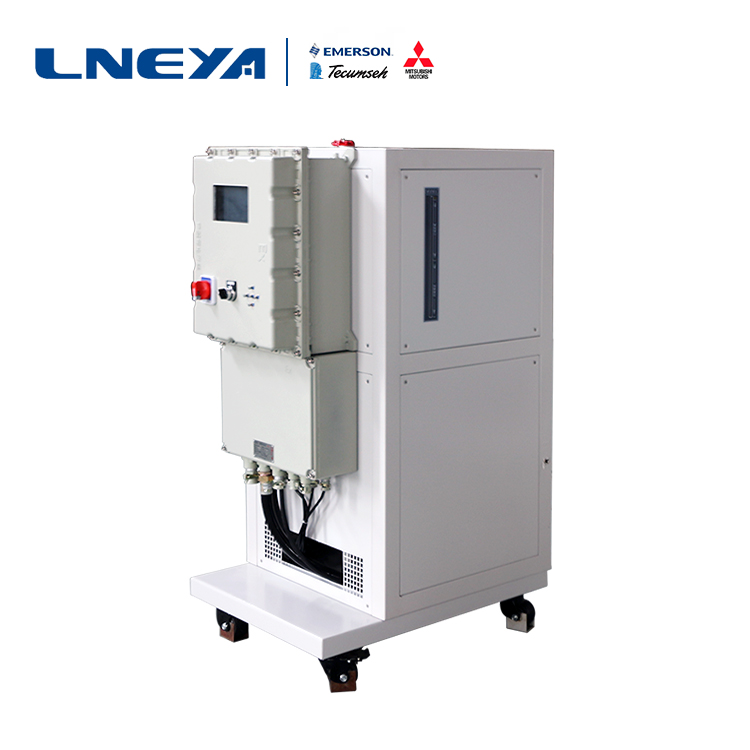
If the linear rapid temperature change tester mixes different types of thermal fluid in the thermal fluid circulation, the linear rapid temperature change tester will be damaged. Different types of thermal fluids (eg mineral oil, silicone oil, synthetic oil, water, etc.) cannot mix with each other in the thermal fluid circulation. When replacing other types of thermal fluid, the thermal fluid circulation must be flushed. The previous thermal fluid is not allowed to remain in the thermal fluid circulation.
The linear fast temperature change tester’s emptying liquid is as shown above. After the process of emptying and adding liquid, the power can be turned on and the linear rapid temperature change tester can operate normally.
Recomendaciones relacionadas
-
Introduction to Low Temp Chillers
1726Low temp chiller is a kind of refrigeration equipment which can provide cold source below 0℃. It generally refers to the use temperature from 5 to 35℃. The refrigerant can be carried by ethylene glycol or calcium chloride aqueous solution, and the...
Ver detalles -

13p semi-closed air-cooled compression condensing unit failure warning instructions
1967The 13p semi-closed air-cooled compression condensing unit is used in industrial cold processing. After using it for a long time, some problems will arise, Wuxi Guanya (LNEYA) reminds. There is usually a high-pressure alarm on the 13p semi-closed ...
Ver detalles -
Energy storage system requirements for temperature-controlled liquid-cooled unit
2051Energy storage system: It needs to meet the discharge demand for a long time. It is suitable for energy storage on the side of new energy generation, arbitrage of peak-valley price difference on the user side, etc. The future trend is that...
Ver detalles -
Operating Principle of LNEYA Industrial Air Cooled Chillers
2131Industrial Air Cooled Chillers is a heatexchanger which USES air to cool the hot fluid. The hot fluid in the tube isheated through the exchange of heat between the tube wall, the fin and theoutside air, which is usually supplied by the ventilat...
Ver detalles