 LNEYA Enfriadoras industriales Fabricante Proveedor


What is a Screw Chiller
While you enjoy a comfortable room temperature in your office building, as equipment in your workshop runs 24/7, screw chillers are quietly working to maintain the right temperature, hidden from view. This article explains what a screw chiller is, its operating principles, and its features. We hope this will help you make a better purchasing decision.
What is a Screw Chiller?
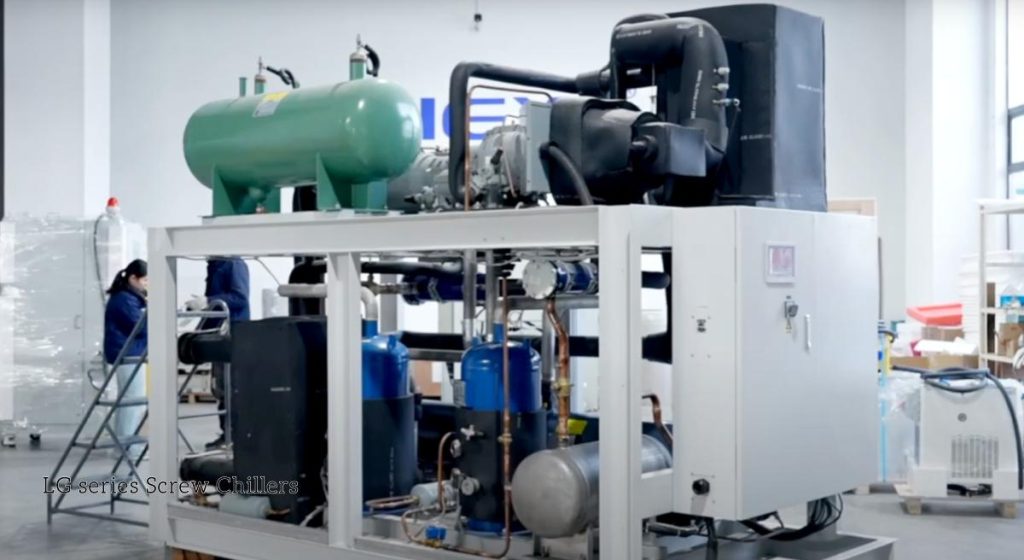
A screw chiller is a type of industrial refrigeration equipment. It’s so called because it uses a screw-type compressor. A screw compressor compresses low-pressure refrigerant gas to high-temperature, high-pressure gas.
This gas is cooled through condensation, throttling, and evaporation. Due to their high cooling efficiency and stable operation, screw chillers are often used in applications with high heat loads, such as HVAC, pharmaceuticals, and chemicals.


How Does a Screw Chiller Work?
The screw compressor is the core component of the screw chiller’s refrigeration cycle, so let’s start by understanding the complete refrigeration process. A screw compressor has two rotors. The drive rotor has raised teeth on its surface, which allows it to rotate actively. The driven rotor has recessed teeth that mesh with the drive rotor and rotate with it.
As the rotor rotates, it draws refrigerant vapor from the suction port into the cavity between the rotor and the casing. The meshing rotors create sealed chambers that trap refrigerant vapor, sealing the gas within the compressor. As the rotors rotate, the teeth of the two rotors gradually mesh, and the sealed cavity between them gradually shrinks.
The refrigerant is continuously compressed as the chamber volume decreases. When the rotors reach the discharge port, the volume of the cavity is compressed to its minimum, and the high-pressure gas is discharged into the condenser.
In the condenser, the heat of the refrigerant gas is removed by water (for water-cooled screw chillers) or air (for air-cooled screw chillers), condensing it into liquid. It then passes through an expansion valve with a wide inlet and a narrow outlet, reducing its pressure and temperature. Finally, it enters the evaporator, where it absorbs heat from the agua refrigerada or air and evaporates. The evaporated refrigerant gas is drawn into the screw compressor and recompressed, beginning the next cycle.
Related: Common Compressor Types
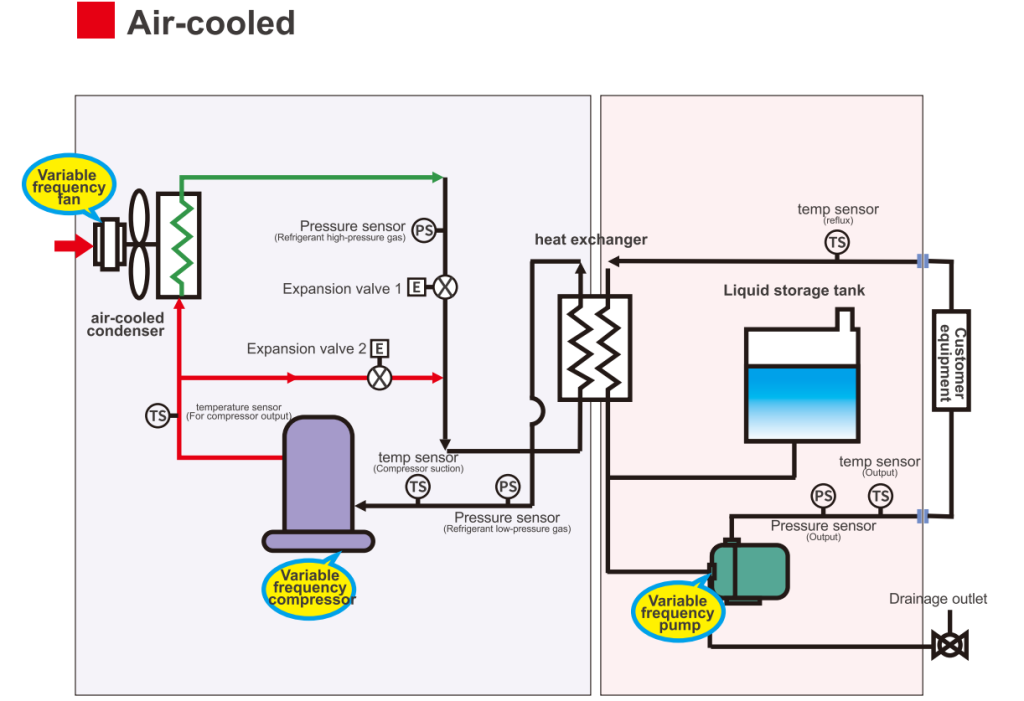
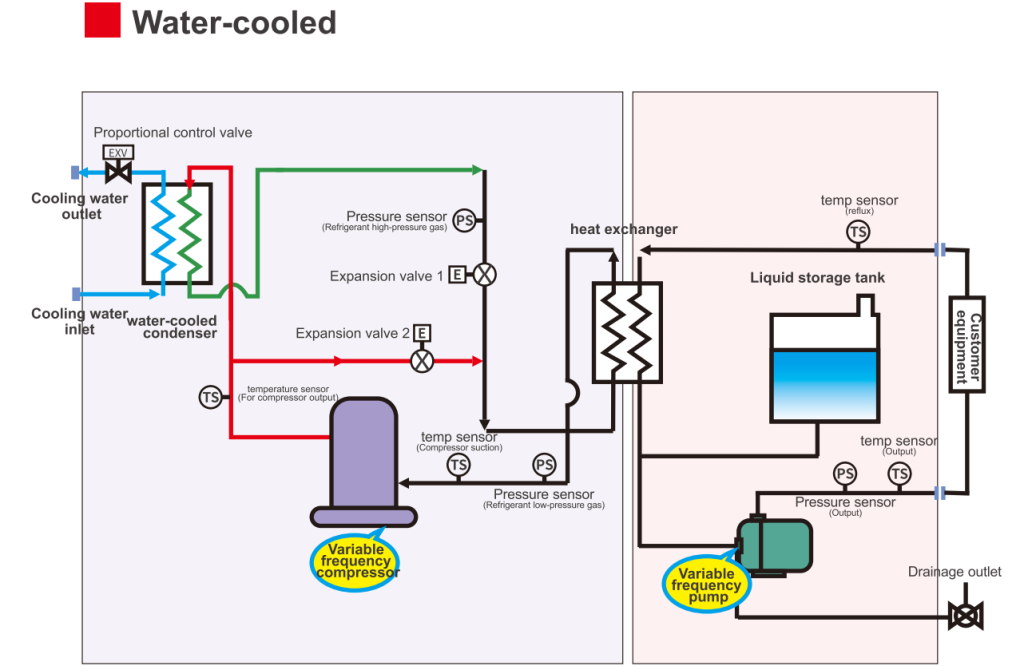
Key Features and Advantages of Screw Chillers
There are many types of chillers, categorized by condensation method, application scenario, and function. Common equipment used for 20L reactor systems is primarily the following:
1. High Cooling Capacity
Screw compressors operate continuously between the suction, compression, and discharge stages. Their large capacity allows them to draw in and compress more refrigerant gas with each rotation, thus providing greater capacidad de refrigeración. This is one of the key reasons why screw chillers are often used in processes with high heat loads.
2. Flexible Energy Adjustment
The cooling capacity demand of industrial chillers varies during operation. Running the equipment at full capacity during low loads wastes electricity and accelerates equipment wear. However, screw chillers can flexibly adjust their cooling capacity based on load.
Two common adjustment methods are slide valve adjustment and variable frequency drive adjustment. A slide valve inside a screw compressor, like a faucet, controls the amount of refrigerant gas drawn in.
Most slide valves can be adjusted continuously between 25% and 100% of cooling capacity. Variable frequency drive using a variable frequency drive (VFD) to adjust the motor speed.
3. High Operational Stability
Compared to piston compressors, screw compressors have fewer internal moving parts and virtually no impact from the reciprocating pistons. This results in less mechanical wear, vibration, and noise. Even under high-intensity, high-cooling-capacity conditions and long-term operation, screw chillers are less prone to overload than smaller chillers.
4. Strong Compatibility
Because screw chillers can adjust their cooling capacity, they operate stably under both low and high load conditions. Furthermore, modern screw chillers are compatible with a variety of refrigerants, may require minor adjustments or compatibility verification when switching refrigerants.

¡Explora soluciones de enfriadores de alta eficiencia y ahorro de energía!
Applications of Screw Chillers
1. Industrial Production
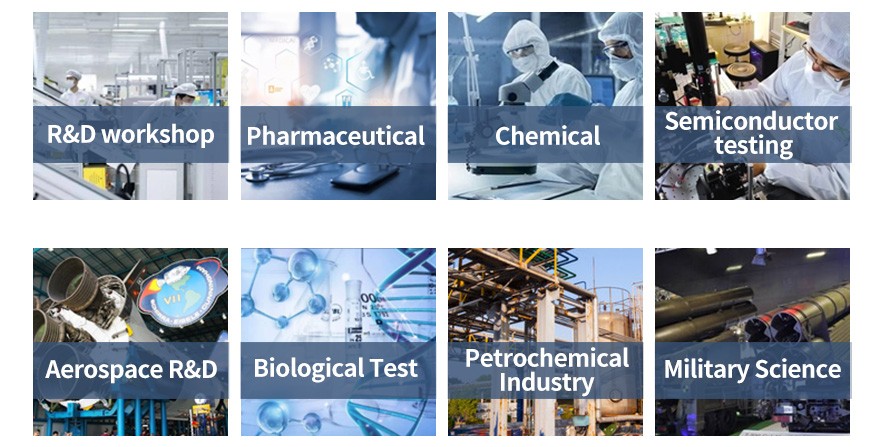
In chemical, plastic injection molding, pharmaceutical, and semiconductor fabs, production equipment requires high temperature stability. Screw chillers can continuously provide tens to thousands of kilowatts of cooling capacity, helping to dissipate heat from equipment in a timely manner.
2. Commercial Buildings
In large shopping malls, office buildings, hotels, and other locations, chillers provide cooling for HVAC systems. Screw chillers, through variable frequency control, can flexibly adjust cooling capacity based on changes in room load, saving electricity while ensuring indoor comfort.
3. Data Centers
Data center servers generate large and frequently fluctuating heat. Screw chillers, combined with cooling towers or air cooling systems, can quickly respond to load changes, maintain stable room temperatures, and reduce server failure rates.
4. Medical and Laboratorio Aplicaciones
Hospital operating rooms and clean areas of laboratories have stringent temperature and humidity requirements. Screw chillers offer high stability and low noise levels, and can be used in conjunction with air handling units (AHUs) for precise temperature control.
5. Central Air Conditioning Systems
Screw chillers are essential equipment in large central air conditioning systems. They can be combined with scroll chillers and centrifugal chillers to meet the temperature control needs of multiple zones and loads.
Conclusión
Screw chillers are commonly used in industrial applications with high heat loads and the need for long-term stable temperature control. Looking for a suitable cooling system? LNEYA offers a variety of screw equipment types and performance levels, along with one-stop customization services, to help you easily meet the temperature challenges of your industry.

Blogs recientes
- What Does a 200 Ton Chiller Cost
- Temperature Control in Photolithography
- Is a Used Chiller a Good Idea
- Chiller Components and Refrigeration Fundamentals Guides
- Chiller Types and Selection Guides
- How Does a Peltier Cooler Work
- Peltier Chiller vs. Compressor Chiller
- What Is a Peltier Chiller
Catálogo
- diciembre 2025
- noviembre 2025
- octubre 2025
- septiembre 2025
- agosto 2025
- julio 2025
- junio 2025
- mayo 2025
- marzo 2025
- febrero 2025
- enero 2025
- diciembre 2024
- noviembre 2024
- octubre 2024
- septiembre 2024
- agosto 2024
- julio 2024
- junio 2024
- mayo 2024
- abril 2024
- marzo 2024
- febrero 2024
- septiembre 2023
- julio 2023
- junio 2023
- mayo 2023
- enero 2023
Etiqueta
refrigerador por aire enfriadora Instalación de enfriadoras Chiller Maintenance chiller refrigerant refrigeradores Montaje en frío Congelador enfriador de refrigeración refrigeración calefacción cooling system sistema dinámico de control de la temperatura chiller de bajo consumo energético enfriador a prueba de explosiones congelador circulador de calefacción enfriadora industrial enfriadoras industriales refrigeración industrial congelador industrial frigorífico industrial reactor de camisa refrigerador de laboratorio refrigerador de baja temperatura noticias enfriador de aceite enfriador de proceso enfriamiento de procesos reactor enfriador refrigeración del reactor refrigeración del reactor calefacción reactor calefacción refrigeración circulador refrigerado refrigerador de tornillo enfriador de semiconductores enfriador de pruebas de semiconductores sundi tcu control de temperatura cámara de pruebas termostato refrigerador de ultra baja temperatura enfriador de pruebas de vehículos enfriador de agua refrigerador por agua
Póngase en contacto con nosotros
Chillers relacionados


CONTÁCTANOS
TEL:
EMAIL:
WeChat & WhatsApp:

Wechat QR

¿Tiene alguna pregunta o necesita un presupuesto? Complete el formulario a continuación y nuestro equipo se pondrá en contacto con usted en 24 horas.

